School of Eros
Where the Sacred Meets the Ordinary
Academics / Schools & Departments
The School of Eros prepares people to live fully alive and to help others do the same. It is dedicated to Eros, the energy that arises from our desire for connection and moves through every act of creation. Where Eros flows, the body comes alive, love becomes a ground of sanity, and each person’s genius finds its way into the world. The school restores this force to the body, health, relationship and community.
The School of Eros is rooted in feminine spirituality. What makes yoga more than calisthenics, or meditation more than zoning out, is a set of protocols that applies attention in a way that makes consciousness more complex. That is how ordinary activity becomes sacred. We took that model and applied it to the most difficult and confounding arena in human experience, sexuality, and the result is Orgasmic Meditation (OM).
From OM came The Eros Sutras, the principles of Eros drawn from the practice and set down in five volumes: principles, tumescence, Orgasmic Meditation, relationship, and liberation and justice. The School of Eros teaches from the sutras. It takes what the practice revealed about how life force moves, what blocks it and what sets it free, and brings that knowledge into the rest of life: into healing, into the way people relate to one another, and into play. Students don’t need to practice OM to study here. The sutras give them a way to recognize Eros wherever it moves, in a body coming back to life, in an honest conversation, in a game that loosens an old role, and to follow it toward flourishing. This is the feminine path the school is built on, one that starts in the body, extends to others and only then reaches the wider world.
Department of Healing States
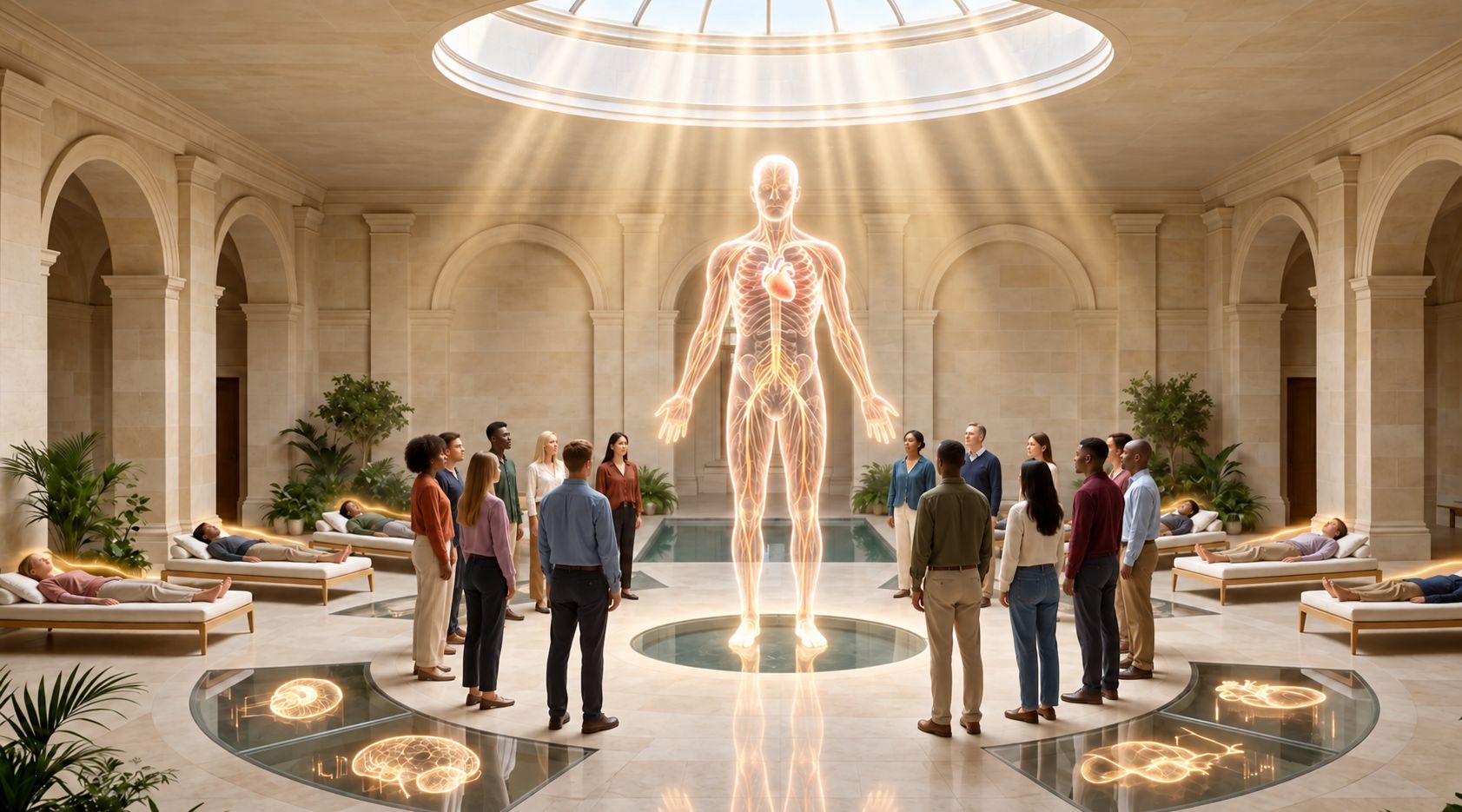
The Department of Healing States studies the return of aliveness to the body and mind. In the philosophy of Eros, much of what we call illness begins where life force has nowhere to go: denied, it builds into pressure and returns as anxiety, rage and, in time, sickness. Healing reverses that movement. It is the return of consciousness to the body and of everything that has been neglected, rejected or left behind, and it comes as a natural byproduct of entering states of greater presence, coherence and aliveness, more than as the correction of symptoms. This is the healthy half of the human story, the half a model of care built around sickness has barely studied, and the department works toward care that starts from flourishing so that relief comes as a side effect. Students study the mystical state, the role of optimal arousal in making the body receptive and capable of transformation, and dreaming as a place where healing continues through the night. They learn to stay lucid and present with what is happening, without withdrawing from difficult sensations or trying to control experience. Everything else the Institute builds starts here, with a single person coming back to life. The expression of flourishing here is vibrancy, responsiveness and inner cohesion.
Department of Relational Arts
The Department of Relational Arts studies connection, the place where Eros moves between people. Eros draws us into contact with life, and relationship is where that contact is tested: it is both a path toward liberation and the place where liberation proves itself. In the philosophy of Eros, true love is an act of becoming, and loving another person into freedom frees oneself as well. Students learn to recognize the fixed roles, defenses, projections and performances that prevent real intimacy, and to remain connected without abandoning themselves or trying to control the other person. The work moves outward the way the Institute builds, from a single person to the couple, then to the table and the community. The study of sangha extends it into how communities of practice are formed, sustained, repaired and organized around a shared purpose, because no one wakes up alone. A person who can stay present in intimacy can stay present in a family, a team or a divided town, and a culture made of such people relates differently to everything it touches. The expression of flourishing here is discernment, engagement and the ability to create real connection.
Department of Infinite Play
The Department of Infinite Play studies play as one of the places Eros moves most freely. Genius is discovery, exploration and play, and it is everyone’s birthright: it emerges when the self stops guarding itself and something new can enter. Play loosens rigid identity, makes experimentation possible and lets people meet one another beyond their habitual roles. Most of the games a culture plays are finite, played to win and then end. The department works from the idea that life can be played as an infinite game, played for the sake of continuing the play, where an obstacle becomes material and losing well becomes a skill. Students study the imaginal mind and the ordinary trance that inherited images create in waking life, and learn through hypnosis and imaginal practice how that trance can be loosened. Then they design games and experiences that let others do the same. A people that can play holds its own forms lightly, and so it can change. The expression of flourishing here is flexibility, and the freedom to meet life as play.